



A contractor website needs to answer three questions quickly: do you handle this type of work, do you serve this area, and can I trust you with my project? If those answers are difficult to find, even a polished website can lose a promising enquiry.
Generating more leads starts with removing uncertainty. For contractors in Montreal, the West Island, and Vaudreuil-Dorion, that means explaining services clearly, showing real work, and making it easy for the right customer to take the next step.
1. A clear introduction to your services and service area
The first screen should explain the work you do and where you do it. “Quality you can trust” could describe almost any business. “Kitchen and bathroom renovations in Montreal’s West Island” gives a prospective customer something useful immediately, if that accurately describes your business.
Pair that message with one primary action, such as requesting an estimate or discussing a project. Give visitors who are still researching a clear route to your services and completed work. Avoid making every button compete for attention.
2. Dedicated pages for your main services
A single list of services rarely answers enough questions. Create a useful page for each distinct service you want to win more work for. Explain what is included, who the service suits, how the process works, and which factors affect the scope.
For example, a bathroom renovation page could discuss layout changes, material choices, project coordination, and what information is needed for an estimate. Keep claims specific to what your business actually delivers. If timelines depend on materials and scope, explain that instead of making a blanket promise.
Useful service pages also provide relevant destinations for search traffic and advertising. Crunch Media’s website design services can help organise these pages around the questions customers ask before hiring.
3. Real project photos with context
A project gallery is more persuasive when visitors understand what they are seeing. Choose a manageable selection of your strongest work and add a short explanation: the project type, the customer’s goal, the work completed, and the challenges your team solved.
- Use clear before-and-after images where they help explain the work.
- Describe the scope rather than relying on photos alone.
- Include a general location only when appropriate and permitted.
- Obtain permission before sharing customer-identifying details or images.
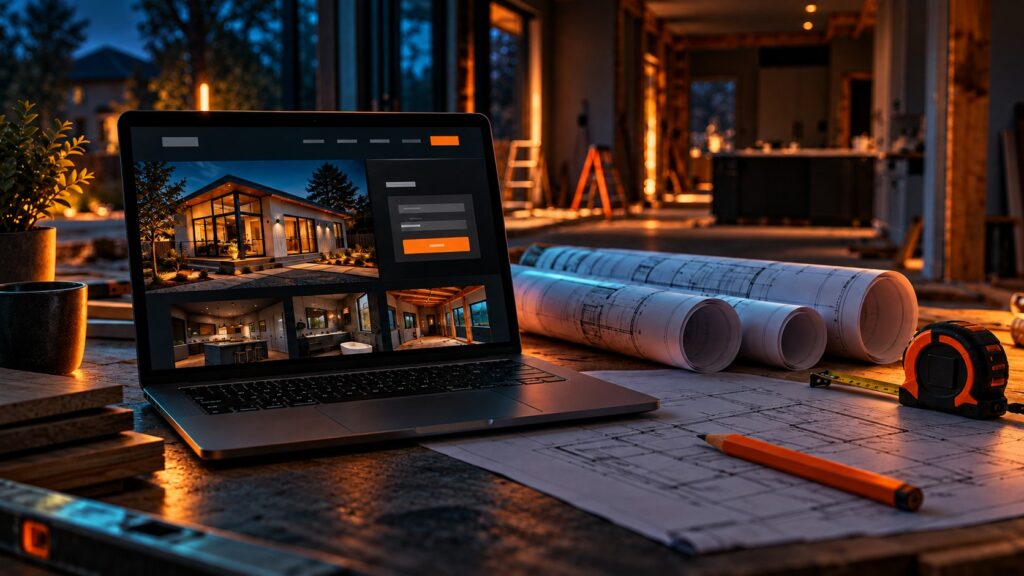
Use genuine project photography as evidence of your work. AI-generated illustrations can support general educational content, but should never be presented as completed jobs or customer properties. The featured image on this article is an illustration, not a contractor’s project portfolio.
4. Trust signals visitors can verify
Show the people behind the company, explain your process, and include authentic customer feedback with appropriate permission and attribution. Where relevant, display accurate credentials and make it easy for visitors to verify them. Avoid unverified badges, vague “best contractor” claims, and testimonials that cannot be substantiated.
A useful process section can be simple: initial enquiry, scope discussion, estimate, scheduling, work, and handover. Adapt it to your actual workflow. Knowing what happens next can help a homeowner feel ready to make contact.
5. A quote form that qualifies without overwhelming
Ask for the information needed to decide whether you can help. Name, contact details, project location, service type, and a short description are often a useful starting point. Add optional photo uploads or timing information only when your team will use them.
If budget is important for screening projects, explain why you ask and use sensible ranges. Requiring a long questionnaire before any conversation can discourage good prospects who are still defining their plans.
Tell visitors what happens after they submit. Promise a response time only if your team can consistently meet it. Test delivery to your inbox and confirm that the customer sees a clear success message.
6. Mobile usability and an obvious contact option
Try requesting an estimate from your own phone. Can you read the page without zooming? Are the buttons comfortable to tap? Does the keyboard match the form field? Can you recover easily from an error?
Include a clickable phone number for people who prefer calling and make the contact page easy to find. Compress large project images and avoid galleries or animations that make the page difficult to use. A fast, clear enquiry path is more valuable than an effect that delays it.
7. Local content that reflects where you actually work
State your real service area and keep business contact details consistent. If you maintain separate pages for different locations, give each page useful, distinct content. Relevant project examples and practical service information are more helpful than a long list of city names.
Support service pages with articles that answer real customer questions, such as how to prepare for an estimate or what influences project scope. For more ideas, see our local SEO tips for service businesses.
8. Lead tracking and a reliable follow-up process
Record where enquiries came from and what happened next. A basic lead log can track the service requested, location, whether the enquiry was suitable, whether an estimate was sent, and whether the job was won.
Review lead quality as well as volume. If many enquiries are outside your area, clarify the service boundaries. If visitors request work you do not offer, adjust the copy. If good enquiries go unanswered, improving follow-up may matter more than buying additional traffic.
A quick contractor website checklist
- Services and service area are clear on arrival.
- Main services have useful, dedicated pages.
- Project photos show authentic work with context.
- Reviews and credentials are accurate and verifiable.
- Quote forms work on mobile and reach the right person.
- Enquiries are tracked through to estimates and booked jobs.
Frequently asked questions
Should a contractor website show prices?
When accurate pricing can be explained clearly, it can help customers assess fit. For custom projects, describe the factors that affect cost and what is required for an estimate. Avoid publishing a starting price that creates a misleading expectation.
Will a new website guarantee more leads?
No. Results also depend on relevant traffic, demand, competition, your offer, and your response process. A better website gives those visitors a clearer path to becoming qualified enquiries.
Make it easier for the right customers to contact you
Crunch Media helps businesses in Montreal and Vaudreuil-Dorion build clearer websites and improve their online marketing. Book a consultation to discuss your contractor website, the projects you want to attract, and the obstacles in your current enquiry process.